Skip to content
SolaGrow
The SolaGrow climate greenhouse in the desert

Concept No plant has been built yet. Illustrations and figures describe the design.

Climate-resilient growing – with shade that generates its own power.

In the SolaGrow climate greenhouse, vertical PV modules turn with the sun. An AI-assisted control system is to decide how much light the crop receives, depending on what the plants need. The modules’ electricity goes mainly into cooling.

AI-generated visualisation

up to 1,000 W/m²

Solar irradiation in arid regions

Heat and radiation put the plants under stress. And day after day the greenhouse has to cool against them.

Where it is hot, the greenhouse itself becomes the problem.

Glass and film are meant to protect plants. In warm regions this turns around: the house traps heat, and operators spend the whole day working against it.

  • Heat and irradiation

    Heat peaks and strong sun put the plants under growth stress. Heat builds up under the cover.

  • Cooling load

    To counter this, the house has to be actively cooled day after day – mostly with purchased electricity and a lot of water.

  • Carbon footprint

    Energy-intensive climate control drives up costs and emissions. On top of that, the CO₂ for the crop often comes from a gas burner.

  • Uneven light

    Shading without light diffusion casts hard stripes of shadow on the plants. That costs yield and quality.

Design and function

The climate greenhouse layer by layer – from the supporting structure to the modules. The visualisation shows the principle, not the construction.

Patent pending (PCT)

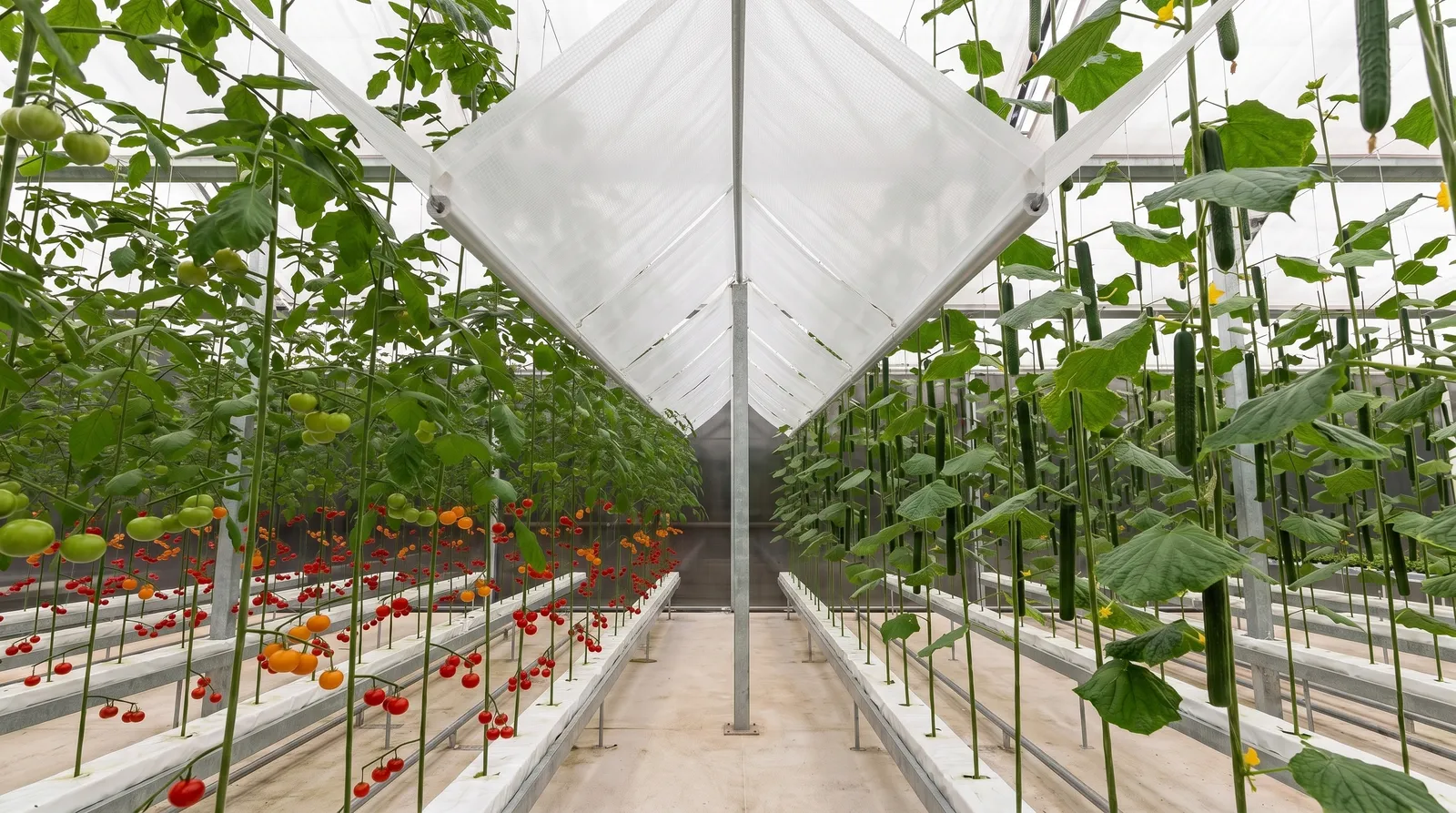
Camera journey through the SolaGrow climate greenhouse: layered structure, growing space below the membrane, module rows in the space frame, evening light

Visualisation of the concept

  1. A house in layers

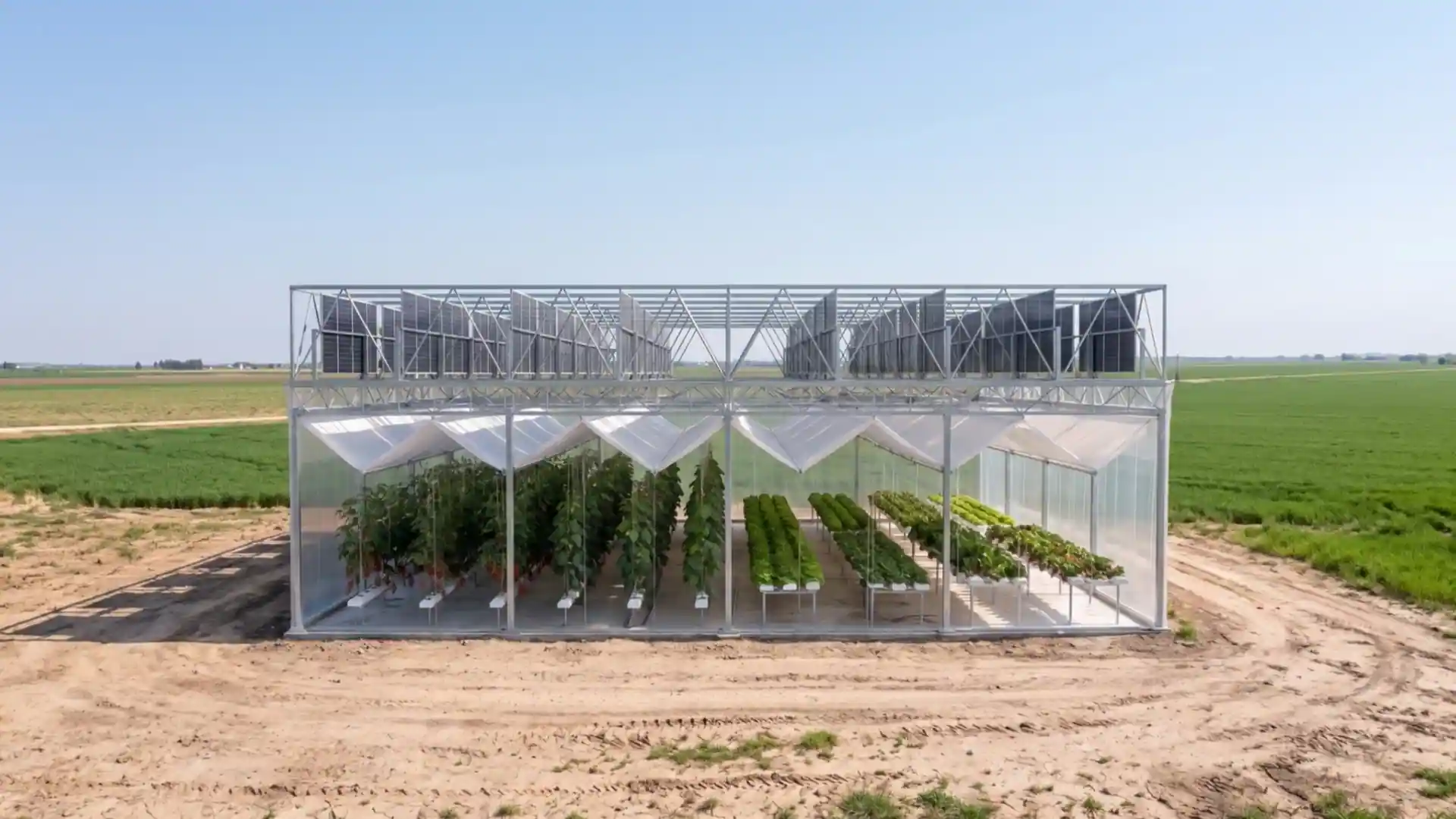
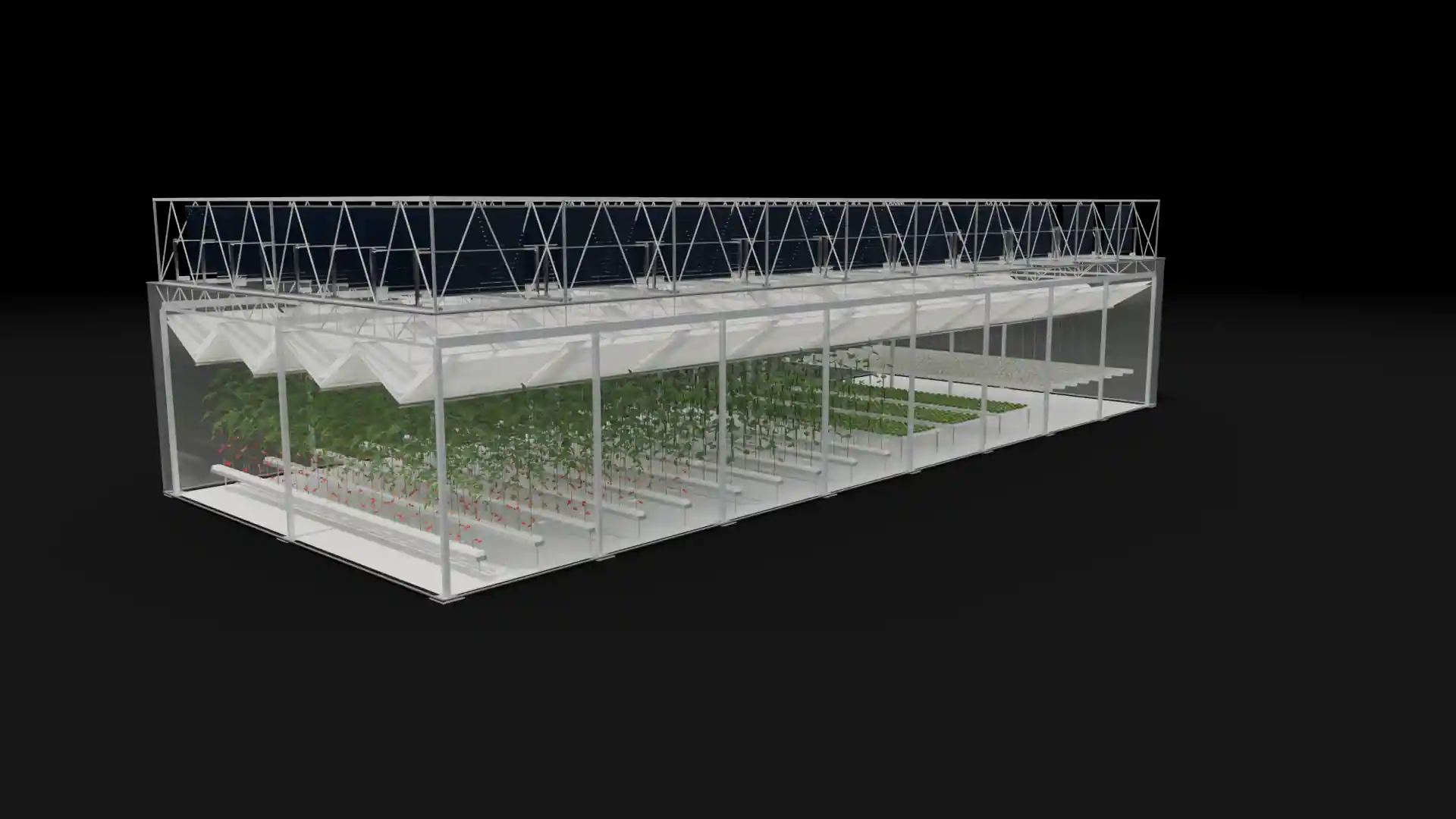
    Below, a proven Venlo structure of columns and lattice girders; above it, an open space frame carrying upright bifacial PV modules. There is no film roof.

  2. Every layer has a task

    Columns and girders carry the load, the membrane diffuses the light, the space frame holds the rails, the modules generate power and the side cover protects the crops. Length, height and crop can be adapted.

  3. Crops grow underneath

    Tomatoes, cucumbers, lettuce or strawberries – depending on region and market. The side cover protects the growing space.

  4. Light, evenly spread

    Below the girders hangs a light-diffusing membrane in a V-shape, with a roller at its lowest point. It spreads the light evenly and prevents hard stripes of shade.

  5. Move, tilt, lift

    The module rows stand on single-arm holders and run on rails: they can be moved, tilted and lifted. How much shade the crops receive is to be decided by an AI-assisted control system, according to what the plants need.

  6. Following the sun

    Through the day the modules follow the sun. In the evening they tilt towards the low sun; their power goes mainly into cooling.
Six components

Each component exists today. What is new is planning them as one system and running it on the greenhouse’s own power.

  • Shade that generates power

    Vertical, bifacial PV modules can be moved, tilted and adjusted in height. How much shade they provide is to be decided by an AI-assisted control system according to what the plants need; their power goes primarily into cooling.

  • Even light

    A light-diffusing membrane is to prevent hard stripes of shadow on the crop and spread the light evenly. Depending on requirements, it has one, two or three layers.

  • Protective cover

    A cover film keeps out wind, sand and snow and at the same time makes it possible to cool the modules.

  • Intelligent control

    Sensors measure light, temperature and soil moisture. The modules position themselves automatically, and each zone of the house is controlled separately.

  • Modular and low-maintenance

    The house is based on the Venlo grid with a lattice-girder substructure. Height, orientation, tilt, membrane layers and crop can be adapted to statics, snow load and crop. Vertical modules hold neither snow nor sand; in a storm they are locked.

  • Low-carbon operation

    Cooling and control run primarily on the greenhouse’s own solar power, supported by storage and load management. CO2 for the crop is produced without combustion instead of in a gas burner.

One concept, three climate zones

The focus is on hot regions. The components stay the same; how much each one is needed depends on the climate. The enclosure is also intended for colder regions with other crops.

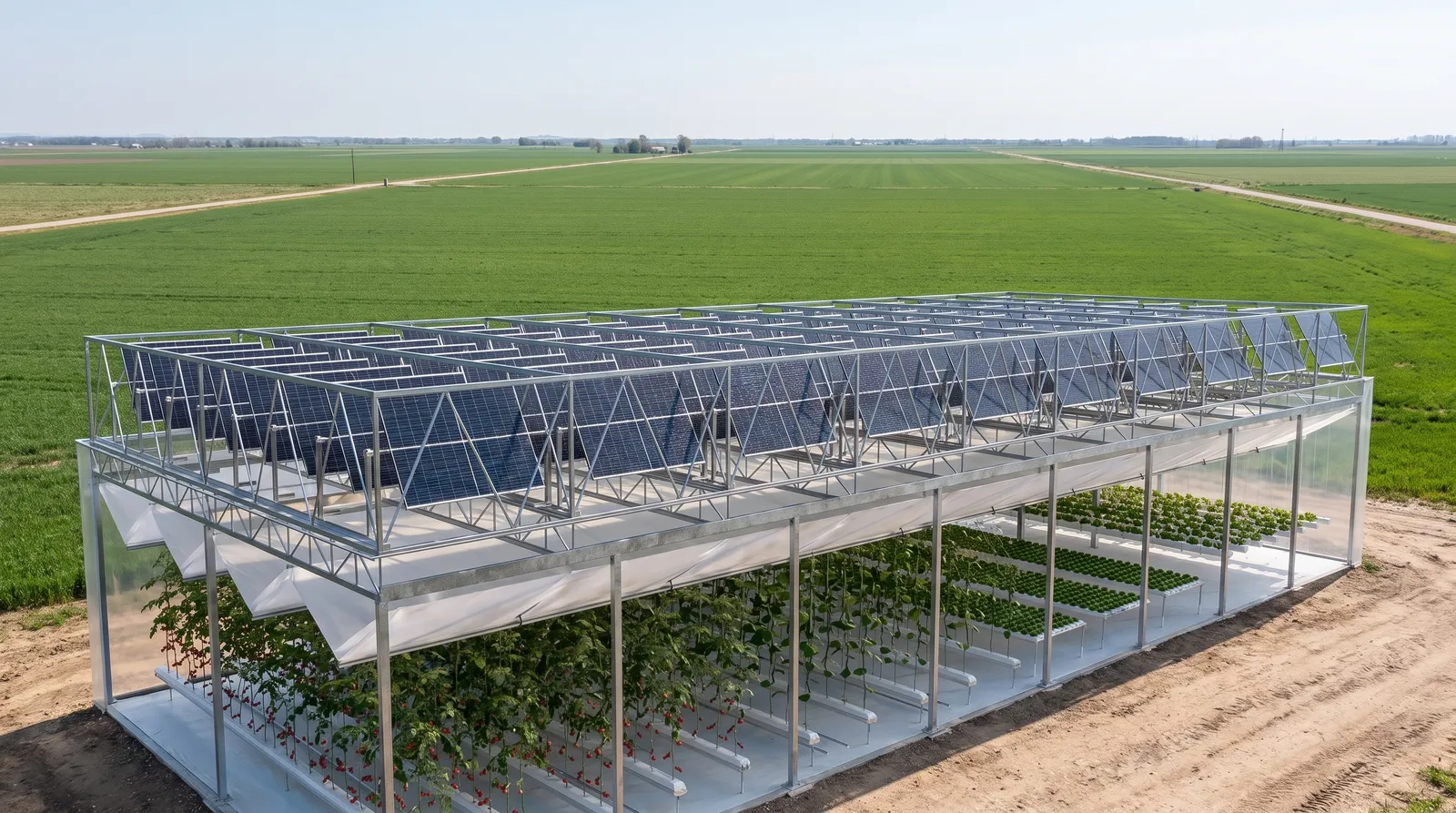
The plant in the desert in the evening sun
Arid regions Irradiation 700–1,000 W/m²

AI-generated visualisation

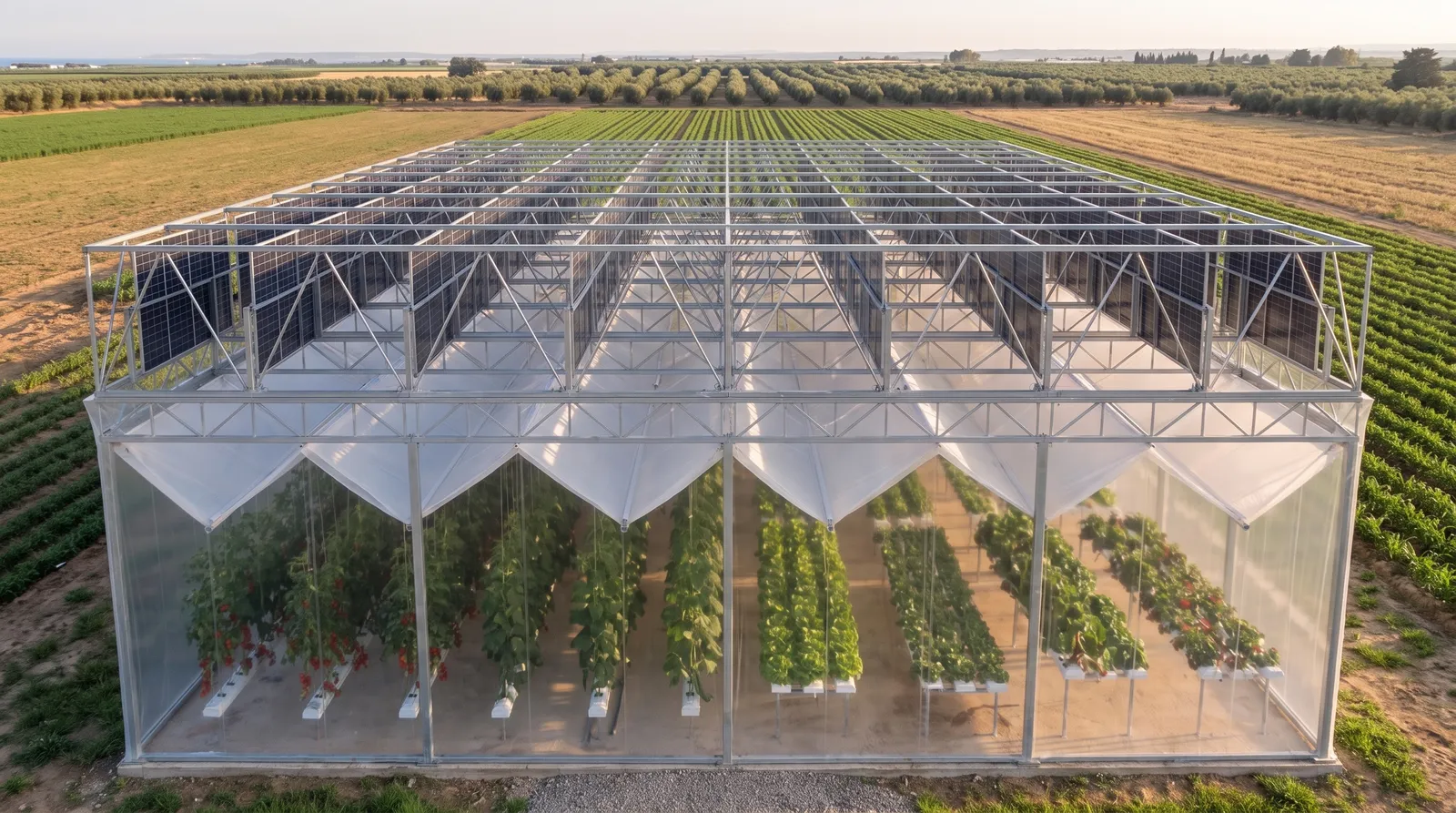
The plant in a hilly landscape with olive trees
Mediterranean regions Irradiation 600–800 W/m²

AI-generated visualisation

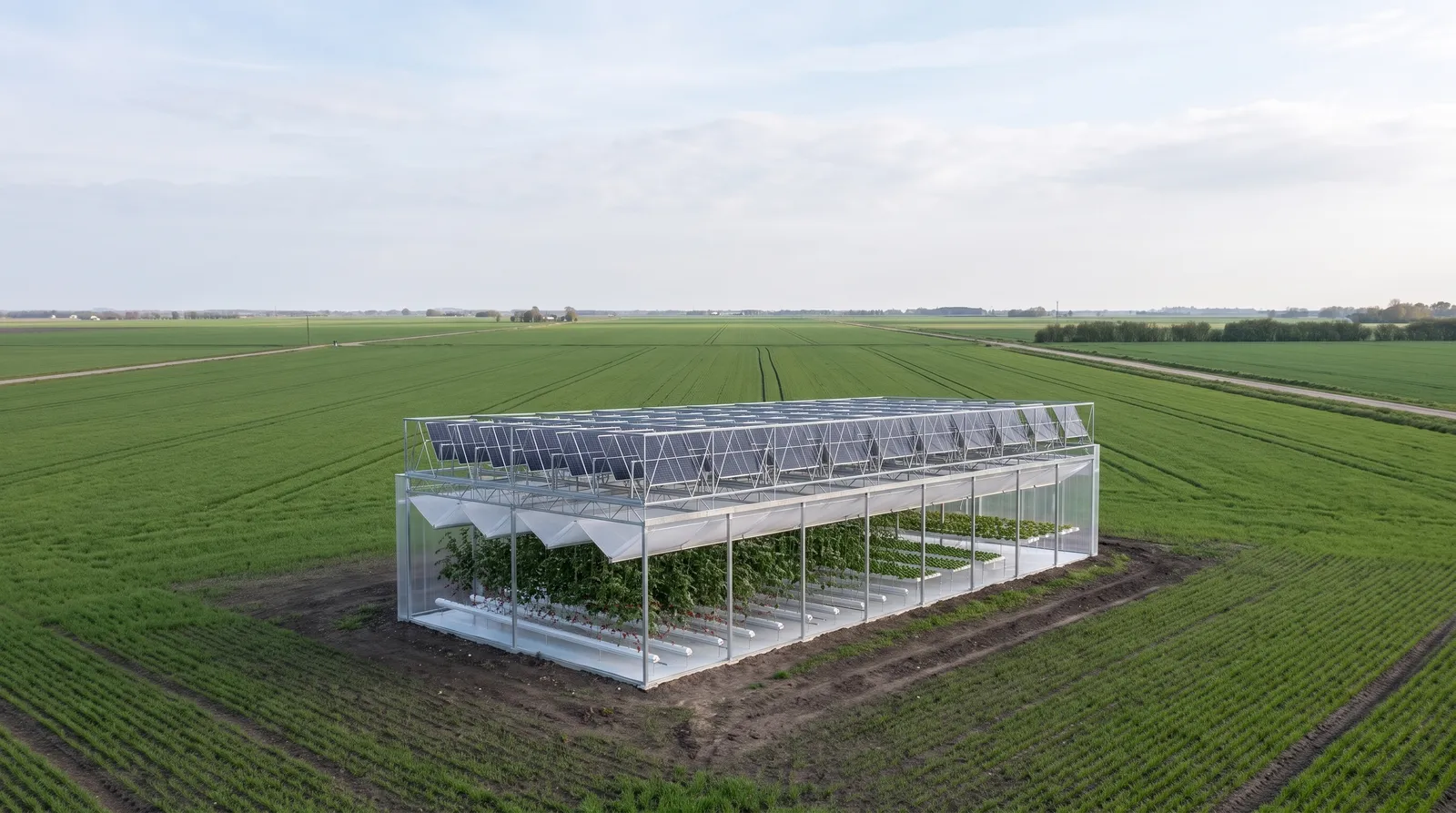
The plant in a Central European farming landscape
Temperate zones Irradiation 400–600 W/m²

AI-generated visualisation

Arid regions

Challenge
Extreme heat, very high irradiation (700–1,000 W/m²) and scarce water.
Response
The modules are to take off the peaks of irradiation when the plants need it and supply the power for cooling. Standing vertically, they do not collect sand.

Mediterranean regions

Challenge
Hot, dry summers with high irradiation (600–800 W/m²) and cooler winters.
Response
In summer the modules supply power for cooling, and the control system is to decide how much shade is right for the crop; in the darker season they are to turn for as much light as possible.

Temperate zones

Challenge
Moderate irradiation (400–600 W/m²), heating demand in winter and strong swings across the year.
Response
In weak sun the modules are to turn for as much light as possible; how much shade falls on the crop in summer is to be decided by the control system. Standing vertically, they do not hold snow.

Conventional and SolaGrow compared

How the concept differs from conventional greenhouse growing in hot regions.

Conventional greenhouse growing and the SolaGrow concept
Aspect Conventional SolaGrow (concept)
Shade Shading without generating power Vertical PV modules follow the sun and generate power; an AI-assisted control system is to decide how much shade falls on the crop.
Light Hard stripes of shadow without light diffusion A light-diffusing membrane is to spread the light evenly.
Cooling Active cooling, mostly with purchased electricity and a lot of water Cooling primarily with the greenhouse’s own solar power, balanced by storage and load management.
CO2 for the crop Often from a gas burner Produced without combustion.

We will determine reliable figures with the first prototype.

Contact

Request a conversation

For partners, investors and project developers who want to examine the concept or develop it further together.

Email: kontakt@solagrow-greenhouse.de
Aldersbach, Germany